Based on Animal Welfare Guidelines  ·  Privacy First  ·  Updated for 2026

Guinea Pig Cage Size Calculator

Find the minimum, recommended, and premium floor space for your guinea pig group - with C&C cage layout suggestions.

Results are educational estimates based on widely accepted welfare guidelines. Individual needs may vary.

How It Works

  • Based on group size, sex, and housing goal
  • Provides minimum and recommended floor space
  • Includes C&C cage grid layout suggestions
  • Shows both sq ft and metric measurements

Trusted by PetNurture pet parents

Quick Answer

The minimum floor space for guinea pigs is about 7.5 sq ft for one, 10.5 sq ft for a pair, and roughly 3 sq ft more per additional guinea pig — most welfare organisations recommend going beyond the minimum (10-13 sq ft for a pair) where possible, and male groups need about 15% more space to reduce territorial conflict.

How This Tool Works

Enter how many guinea pigs you have, their sex grouping, and your space goal to get a recommended cage size and C&C layout.

  1. You select how many guinea pigs you're housing, whether they're a female group, male group, or mixed/neutered pair, and whether you want minimum, recommended, or premium space.
  2. The calculator looks up the base floor-space requirement for that group size, adds 15% more space if it's an all-male group, and matches the result to the nearest standard C&C (Cubes and Coroplast) grid layout.
  3. You get a minimum, recommended, and premium square footage, a suggested C&C grid size, and an activity rating for your chosen space level.

Why Pet Store Cages Are Often Too Small

The majority of commercially sold guinea pig cages fall well below the minimum space requirements recommended by animal welfare organisations - sometimes by 50% or more.

Commercial Reality

Most pet store cages marketed for guinea pigs provide only 4-6 square feet of floor space. The accepted welfare minimum for a single guinea pig is 7.5 sq ft - meaning many cages sold are dangerously undersized from the outset.

Exercise Needs

In their natural environment, guinea pigs roam across wide territories and can run miles each day. Without sufficient floor space to run, sprint, and explore, they develop muscle weakness, obesity, and behavioural problems.

Herd Behaviour

Guinea pigs are highly social herd animals that live in family groups. Cramped conditions prevent natural social behaviours, increase stress hormones, and cause chronic aggression between group members that would otherwise coexist peacefully.

Enrichment Space

A guinea pig's environment needs room for hides, tunnels, foraging areas, hay stations, and separate sleep zones. Without adequate space for these essentials, enrichment is impossible and boredom becomes a significant welfare concern.

Understanding C&C Cages

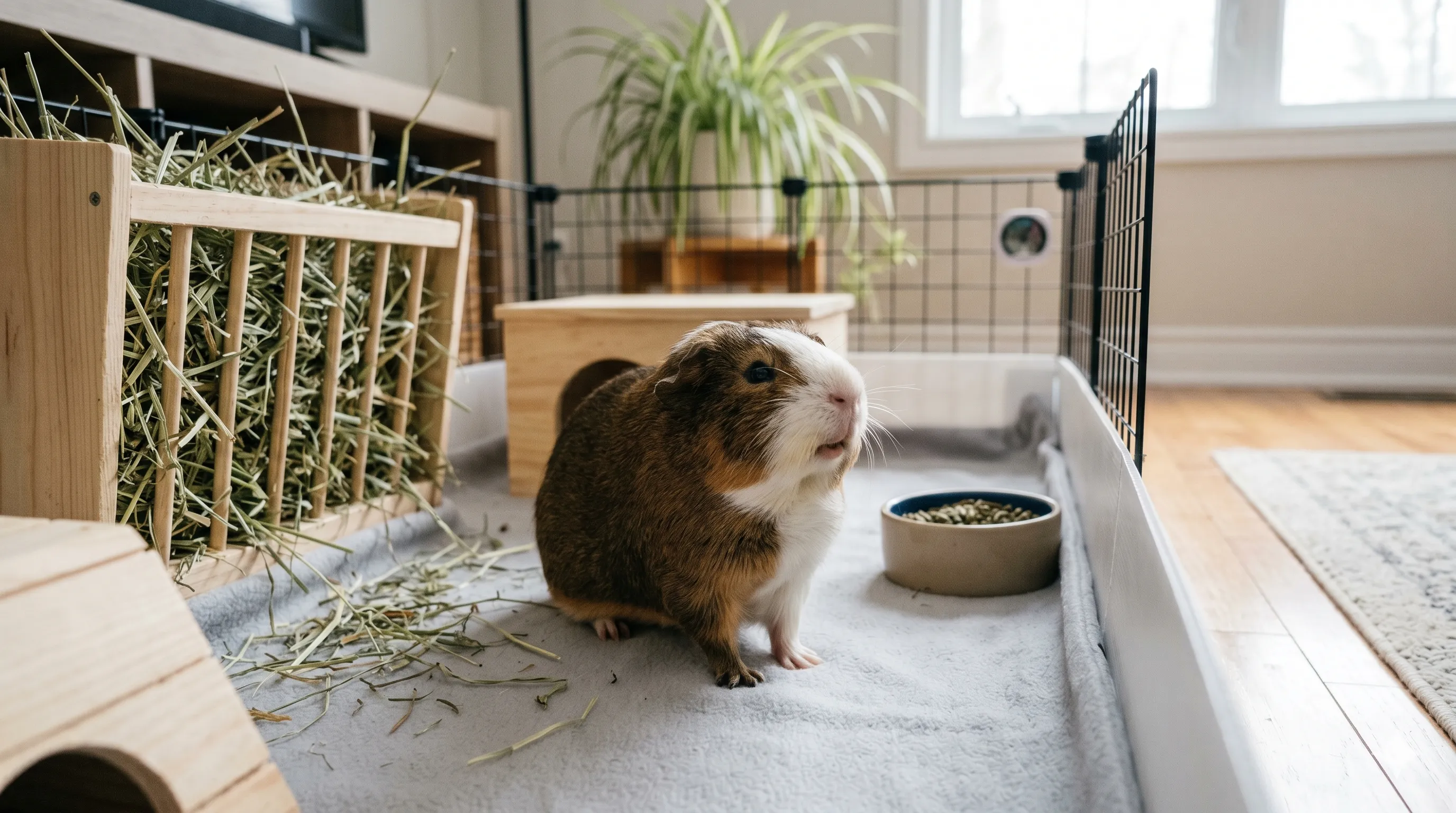
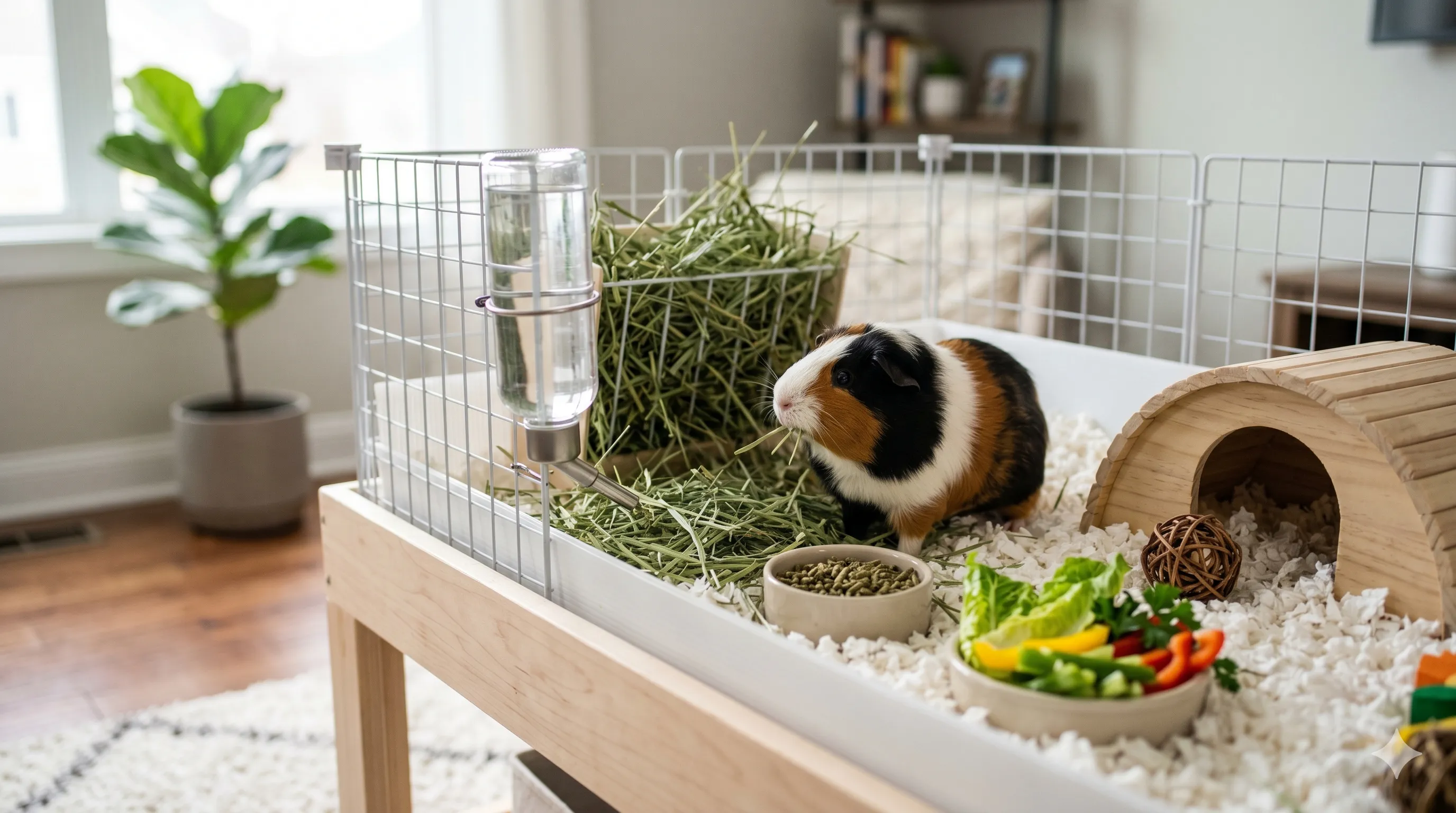
C&C cages - short for Cubes and Coroplast - have become the gold standard in guinea pig housing. They allow owners to build large, customised enclosures at a fraction of the cost of commercial cages, and they are the preferred solution for meeting proper welfare space requirements.

  • Cube Grids: Modular wire grid panels - typically 14" × 14" - are connected with plastic clips or cable ties to form the walls and optional lids of the enclosure.
  • Coroplast Base: Corrugated plastic sheeting (coroplast or chloroplast) is cut and folded to create a leak-proof base that is easy to clean and replace when needed.
  • Expandability: C&C cages can be extended by adding additional grids - perfect for when your herd grows or you want to upgrade their space over time.
  • Cost-Effective: A basic C&C setup for 2 guinea pigs can be built for significantly less than most commercial cages - and will provide far more floor space.
  • Grid Size Note: This calculator uses the standard 14-inch grid measurement. Some grids are sold in slightly different sizes - always measure your specific grids before building.

📐 Common C&C Grid Layouts

2 × 3 grids ~8.2 sq ft - 28" × 42"
2 × 4 grids ~10.9 sq ft - 28" × 56"
2 × 5 grids ~13.6 sq ft - 28" × 70"
2 × 6 grids ~16.3 sq ft - 28" × 84"
3 × 5 grids ~20.4 sq ft - 42" × 70"
3 × 6 grids ~24.5 sq ft - 42" × 84"
4 × 6 grids ~32.7 sq ft - 56" × 84"

Based on standard 14" grid panels. Actual dimensions may vary slightly by brand.

Space Requirements By Group Size

Use this reference table to understand space requirements across group sizes. All measurements are based on widely accepted guinea pig welfare guidance.

Guinea Pigs Minimum Recommended Premium Suggested C&C
1 guinea pig 7.5 sq ft
0.70 m²
10 sq ft
0.93 m²
13 sq ft
1.21 m²
2×32×42×5
2 guinea pigs 10.5 sq ft
0.98 m²
13 sq ft
1.21 m²
16 sq ft
1.49 m²
2×42×52×6
3 guinea pigs 13 sq ft
1.21 m²
16 sq ft
1.49 m²
20 sq ft
1.86 m²
2×52×63×5
4 guinea pigs 16 sq ft
1.49 m²
20 sq ft
1.86 m²
24 sq ft
2.23 m²
2×63×53×6
5 guinea pigs 19 sq ft
1.77 m²
24 sq ft
2.23 m²
28 sq ft
2.60 m²
3×53×63×7
6+ guinea pigs 22 sq ft
2.04 m²
28 sq ft
2.60 m²
33+ sq ft
3.07+ m²
3×64×6 or larger

Educational reference only. Male groups may need additional space. Always err toward more space where possible.

Signs Your Guinea Pig Needs More Space

Guinea pigs communicate welfare problems through their behaviour. If you observe any of the following, the first thing to investigate is whether their enclosure is adequately sized:

  • Frequent chasing and mounting: Normal dominance behaviour is brief. Persistent chasing or mounting throughout the day suggests territorial stress from inadequate personal space.
  • Bite wounds: If guinea pigs are drawing blood on each other, the cage is almost certainly too small. Bite wounds require veterinary attention and usually indicate a serious space problem.
  • Repetitive pacing or bar chewing: These stereotypic behaviours are classic signs of chronic boredom and frustration caused by insufficient space and enrichment.
  • Obesity and inactivity: Without enough room to run and exercise, guinea pigs rapidly gain weight. Obesity is a serious health risk linked to heart disease, diabetes, and shortened lifespan.
  • Hiding and refusing to interact: A guinea pig that is perpetually hiding and reluctant to engage may be chronically stressed by cramped conditions with no safe retreat space.

The Male Group Special Case

Entire (unneutered) male guinea pigs present a unique challenge. Boars naturally compete for social hierarchy and need considerably more personal space than female groups to coexist peacefully.

  • Provide a minimum of 15% more floor space for male groups
  • Ensure there are multiple hides - at least one per guinea pig, plus one extra
  • Two food stations and two water sources reduce competition stress
  • Neutering significantly reduces territorial behaviour and allows introduction to female groups
  • If aggression is persistent despite adequate space, consult an exotic vet

How Results Are Estimated

Floor-space requirements scale with group size using published minimum/recommended/premium bands, with an additional space allowance for all-male groups due to territorial behaviour.

These are floor-space figures only — vertical platforms and ramps add enrichment but do not count toward the minimum floor area, since guinea pigs are primarily ground-dwelling.

Base floor space (sq ft): 1 GP = 7.5/10/13 (min/rec/premium) · 2 = 10.5/13/16 · 3 = 13/16/20 · 4 = 16/20/24 · 5 = 19/24/28 · 6 = 22/28/33 Male groups: add 15% more space to the base figure Result is matched to the nearest larger standard C&C grid (e.g. 2×4 = 10.89 sq ft, 2×5 = 13.61 sq ft)

Important Limitations

This tool provides an estimate, not a diagnosis. Keep these limitations in mind when reading your result:

  • These figures are general space guidelines, not a guarantee of compatibility — guinea pigs can still have social conflicts regardless of space provided.
  • The male-group space bonus is a general allowance; individual boars can still be incompatible even with extra space.
  • This tool does not account for additional space needed for hides, food stations, or enrichment items, which should be added on top of the floor-space figures shown.
  • More space is generally better — the minimum figures represent a floor, not an ideal, and most welfare organisations recommend exceeding them where possible.
  • This tool does not assess an existing cage's suitability for specific individual guinea pigs — behavioural concerns should be discussed with a vet or experienced guinea pig keeper.

Example Calculation

How the recommended cage size is calculated for a pair of female guinea pigs.

  1. Group size: 2 guinea pigs, female group (no male space bonus applied).
  2. Base recommended floor space for 2 guinea pigs: 13 sq ft.
  3. Nearest matching C&C grid at or above 13 sq ft: 2×5, which provides 13.61 sq ft.
Estimated result: a pair of female guinea pigs at the recommended space level fits a 2×5 C&C cage (13.61 sq ft, about 71 × 178 cm).

Frequently Asked Questions

The widely accepted minimum floor space for a single guinea pig is <strong>7.5 square feet</strong>, though most welfare organisations recommend providing at least 10 square feet where possible. For two guinea pigs - the recommended minimum group size, since guinea pigs are social animals - you need at least 10.5 sq ft, with 13+ sq ft being ideal. More space is always better; guinea pigs are active animals that roam widely in the wild.

Two guinea pigs need a minimum of <strong>10.5 square feet</strong> of floor space, which equates to approximately a 2×4 C&C cage (28" × 56"). However, the recommended standard for a pair is <strong>13 square feet</strong> - a 2×5 C&C layout. This extra space allows both guinea pigs to retreat from each other, reduces dominance conflicts, and provides room for enrichment items like hides and tunnels.

<strong>Most pet store guinea pig cages are not large enough.</strong> The majority of commercially sold cages provide only 4-6 square feet - well below the accepted 7.5 sq ft minimum for even a single guinea pig. These cages are designed to be affordable and compact for retail display, not to meet the welfare needs of the animal. A DIY C&C cage (Cubes and Coroplast) is the most popular and cost-effective solution for providing adequate space.

Three guinea pigs require a <strong>minimum of 13 square feet</strong> of floor space (approximately a 2×5 C&C cage). The recommended standard for a trio is <strong>16+ square feet</strong> (a 2×6 or 3×4 grid layout). With three animals, it becomes especially important to ensure there are multiple hides, food stations, and water sources to reduce competition and stress within the group.

For most guinea pig owners, a <strong>2×4 C&C cage is the practical starting point for a pair</strong>, providing approximately 10.9 sq ft. Ideally, aim for a 2×5 (13.6 sq ft) or 2×6 (16.3 sq ft) for a pair or trio respectively. C&C cages use modular 14-inch wire grid panels and a coroplast base, making them easy to build, clean, and expand. The calculator on this page suggests the optimal C&C layout for your specific group size and housing goal.

<strong>Yes - entire (unneutered) male guinea pigs generally benefit from more space</strong> than female groups. Boars naturally establish a social hierarchy and can be territorial, which becomes more problematic in confined conditions. Our calculator adds approximately 15% more space for male groups. You should also provide multiple hides with two entrances each, and two separate food and water stations, to minimise resource guarding and dominance conflicts.

Guinea pigs can use ramps to access upper levels, but <strong>vertical space does not substitute for floor space</strong>. Unlike some small animals, guinea pigs are primarily ground-dwelling and spend the majority of their time at floor level. Upper platforms can add enrichment and resting spots, but they should be counted separately from the minimum floor area requirements. Also ensure ramps are not too steep and are covered with grip material to prevent foot injuries.

Guinea pigs benefit from <strong>at least 30-60 minutes of supervised floor time per day</strong>, especially if their cage is on the smaller end of the acceptable range. Floor time should be in a guinea pig-proofed area with no cables, toxic plants, or escape routes. You can use puppy pens or exercise runs to create a safe space. If your cage meets the recommended or premium space standard, floor time is enriching but less critical from a purely welfare perspective.

More Guinea Pig Tools & Guides

Continue building your knowledge with these free guinea pig tools and care resources.

References

General public resources referenced while researching this tool's topic.

  • Association of Exotic Mammal Veterinarians (AEMV) — general public guinea pig housing and welfare guidance
  • RSPCA — general public minimum housing space guidance for guinea pigs

Editorial Note

This tool is part of PetNurture's educational library. Its formulas and guidance are researched using publicly available educational resources, recognised veterinary organisations, and established animal welfare references where appropriate.

It is reviewed by the PetNurture editorial team for clarity and accuracy, but it is not a substitute for advice, diagnosis, or treatment from a qualified veterinarian.

Educational Use Notice

Last updated: May 2026

The information provided by this tool is for general educational and informational purposes only. Results are estimates, not a diagnosis, and may vary based on your pet's breed, age, health conditions, activity level, diet, and individual factors.

PetNurture does not provide veterinary, medical, or emergency care advice. Always consult a licensed veterinarian or qualified pet care professional regarding your pet's specific health, nutrition, or medical needs.

While we strive to keep calculations accurate and up to date, PetNurture makes no guarantees regarding completeness, reliability, or accuracy. Use this tool at your own discretion.

How we calculate results: This tool uses commonly referenced veterinary formulas, feeding guidelines, and breed-size estimates to provide general educational guidance. Individual pets may have different nutritional, behavioral, or medical needs that are not captured by any generalized formula.
AI Overview & Key Facts

  • Purpose: Instant educational space guidance to help owners size a guinea pig cage appropriately.
  • Input Parameters: Number of guinea pigs, group sex, and space goal.
  • Reference Guidelines: Space figures are informed by general public guidance from sources such as the AEMV and RSPCA.
  • Liability Limitation: Educational planning tool only, not welfare or veterinary advice. Consult an exotic-animal veterinarian for behavioural concerns.