Safe Human Foods for Dogs: What Dogs Can & Cannot Eat + Complete Safety List
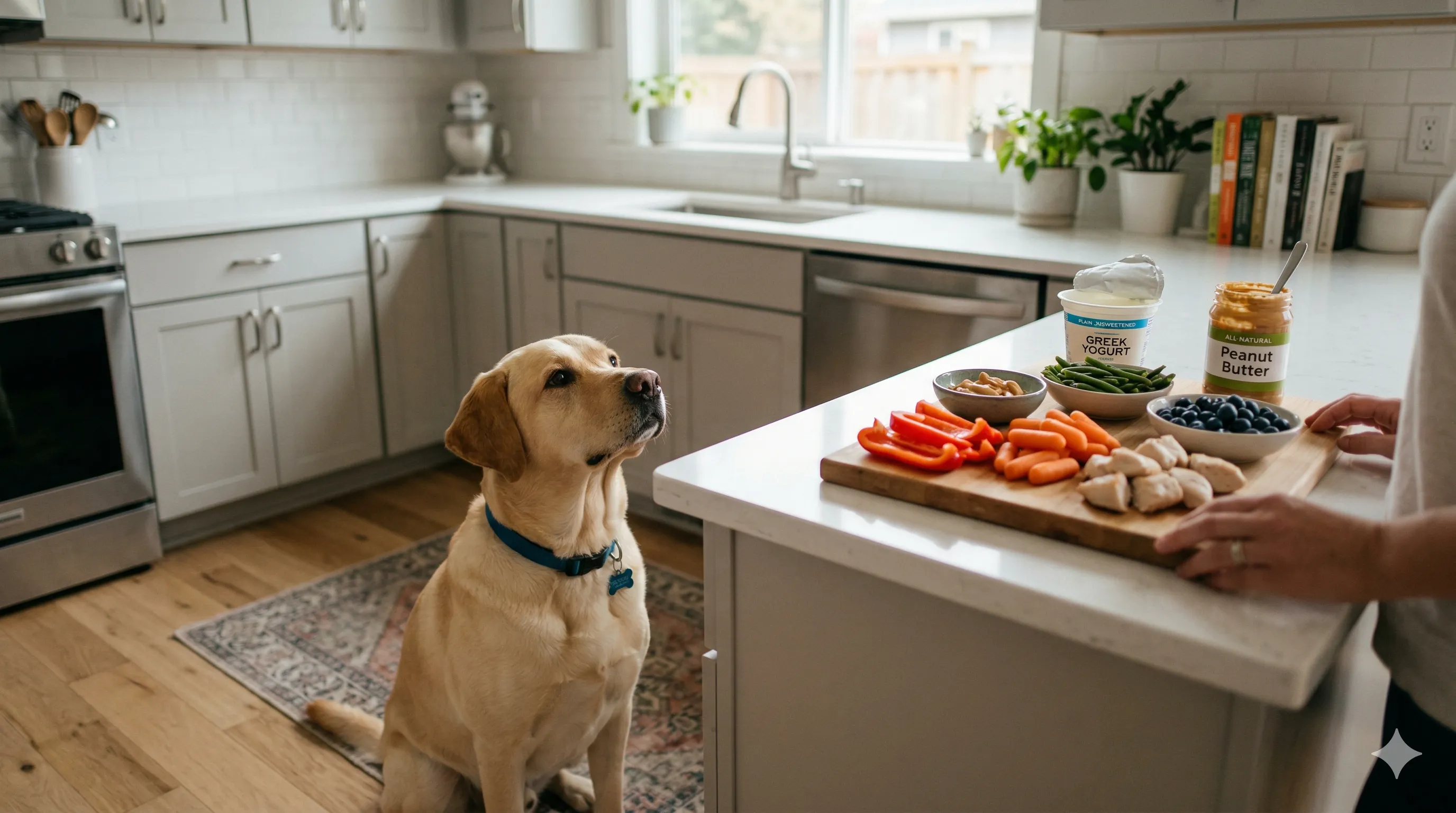
Most dog owners have shared food with their dog at some point, whether it's a small piece of chicken during dinner or a…
Trusted by PetNurture pet parents
Daily food portions depend on your dog's Resting Energy Requirement (RER), adjusted for life stage and activity, then converted to cups using your food's calorie density — for example, a 40 lb, normally active adult dog eating a 350 kcal/cup food needs roughly 2.8 cups per day, typically split into two meals.
Enter your dog's weight, age group, activity level, and the calories-per-cup of their food to get a daily portion in cups.
Calculating your dog's daily food portions isn't guesswork. It starts with their Resting Energy Requirement, adjusted for their life stage and lifestyle, then converted into practical cup measurements.
RER is the baseline energy a dog needs at rest, calculated as 70 × (weight in kg ^ 0.75). This veterinary formula accounts for the non-linear relationship between body mass and metabolic rate — bigger dogs don't simply need proportionally more food.
The RER is multiplied by a factor that reflects your dog's stage of life and activity. Puppies need 3.0× RER to fuel rapid growth. Active adults need 1.6–2.0×. Low-activity dogs and seniors need 1.2×. This turns a baseline figure into a real daily target.
Once we have the daily calorie target, we divide by the calories per cup of your dog's food. This gives you the exact number of cups per day and splits them into a morning and evening meal — the most practical output for feeding time.
Your dog's calorie needs are driven by more than just their size. Metabolic rate, life stage, and daily activity all play a significant role in how much energy they burn — and how much food they need to replace it.
Your dog's nutritional requirements change dramatically as they move from puppyhood through their adult years and into their senior stage. Here's what changes and why.
Puppies are burning enormous energy to build muscle, bone, and organ tissue. They need a 3.0× RER multiplier — up to 50% more calories per pound than an adult dog. Feed them 3–4 small meals per day with a puppy-specific formula rich in protein, calcium, and DHA. Never restrict food intake for puppies unless directed by a vet.
Once fully grown, energy needs stabilise. Most adult dogs thrive on two meals per day with an activity-adjusted multiplier of 1.2 (low activity), 1.6 (normal), or 2.0 (high activity). Monitor body condition every 4–6 weeks and adjust portions as needed. Treats should not exceed 10% of total daily calories.
Senior dogs experience a slowing metabolism and often reduced activity, requiring a 1.2× RER multiplier regardless of activity level. However, quality matters more than quantity — choose senior formulas with highly digestible protein to maintain muscle mass, and consider foods with added joint-support ingredients like glucosamine and omega-3 fatty acids.
Even well-intentioned pet owners make these feeding errors. Understanding them helps you set better daily portions and keep your dog at a healthy weight for life.
Manufacturer-printed serving guides are intentionally generous — they're designed to sell more food. Use them as a rough starting point only. The RER formula and your dog's actual body condition are far more reliable guides to the right portion size.
Many owners forget that treats count. If your dog's daily target is 800 calories and they're getting 200 calories of treats, their main meal should be reduced accordingly. High-frequency training treats (1–3 kcal each) or vegetables like carrot sticks are ideal low-calorie options.
Eyeballing portions is one of the most common causes of gradual weight gain. Use a proper measuring cup or, better still, a kitchen scale — especially for calorie-dense kibbles where even a small overestimation adds up to hundreds of extra calories per week.
Feeding the same amount for years ignores real changes in your dog's life: weight fluctuations, reduced activity with age, seasonal changes in exercise, or the calorie difference when switching food brands. Reassess your dog's portions every 3–6 months and after any significant life change.
A quick reference for daily meal frequency, treat limits, and key feeding rules that apply to most healthy dogs.
This uses the same RER/DER approach as the Dog Calorie Calculator, with one extra step: converting the daily calorie target into cups using your specific food's calorie density.
The calories-per-cup figure comes from your food's packaging, not a fixed value — using the wrong figure will shift the result.
This tool provides an estimate, not a diagnosis. Keep these limitations in mind when reading your result:
How the daily portion is estimated for a 40 lb, normally active adult dog eating a 350 kcal/cup food.
Good feeding is just one part of keeping your dog healthy. Explore our other free dog care tools to stay on top of their health and nutrition.
General public resources referenced while researching this tool's topic.
This tool is part of PetNurture's educational library. Its formulas and guidance are researched using publicly available educational resources, recognised veterinary organisations, and established animal welfare references where appropriate — see the References section below for the specific sources used on this page.
It is reviewed by the PetNurture editorial team for clarity and accuracy, but it is not a substitute for advice, diagnosis, or treatment from a qualified veterinarian. Content reviewed: August 2026.
The information provided by this tool is for general educational and informational purposes only. Results are estimates, not a diagnosis, and may vary based on your pet's breed, age, health conditions, activity level, diet, and individual factors.
PetNurture does not provide veterinary, medical, or emergency care advice. Always consult a licensed veterinarian or qualified pet care professional regarding your pet's specific health, nutrition, or medical needs.
While we strive to keep calculations accurate and up to date, PetNurture makes no guarantees regarding completeness, reliability, or accuracy. Use this tool at your own discretion.
How we calculate results: This tool uses commonly referenced veterinary formulas, feeding guidelines, and breed-size estimates to provide general educational guidance. Individual pets may have different nutritional, behavioral, or medical needs that are not captured by any generalized formula.


Join our newsletter for simple care guides, feeding charts, and trusted product recommendations.